
 |
|


 |
|






|
||||||||||||||||||||
|
|
|
|
|
|
|
|
|
|
|
|
|
|
|||||||
|
|
|
|
|
|
|||||||||||||||
|
|
|
|
|
|
|||||||||||||||
|
|
|
|
|
|
|||||||||||||||
 |
||||||||
Such a peculiar surname usually requires it is spelled, especially when registering official documents, otherwise administrative mistakes could be made. But, what did it happen centuries ago when our ancestors, as most of the population, were illiterate and did not know how to write their surname? According to members of the Catalan Society of Genealogy (‘Interesting links’ section), it usually happened in Catalonia that a surname was written in different ways within a same family line because those family members did not know how to write it. |
||||||||
|
Different
ways of writing Orobitg |
 |
|||||||
|
XIII
century – ORVIG: |
||||||||
XIV
century – ORVIG, ORBIG, OROVIG: XV century - OROVIG:
XVI century –
OROVIG: XVII – OROVIG,
OROVITG, OREVITG: XVIII century –
OROVITG: XIX century –
OROVITG, OROBITG: XX century –
OROBITG: |
||||||||
|
Two
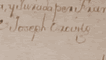
examples from the XVIII century In 1772 Mr Jaume Orovitg signed this document using a clear understandable calligraphy, in contrast with the writing of the notary itself (bottom part of the document). Mr Jaume Orovitg lived in Cervera and belonged to a branch that was member of the builders association, thus having received a good education. Curiously, Mr Jaume Orovitg wrote his surname using ‘v’, whereas he wrote the surname of his father, Mr Francesch Orobitg differently (b)! |
||||||||
 |
Transcription: "... per mi Jaume Orovitg y per Francesch Orobitg mon pare y de sa voluntat firmo jo Jaume Orovitg. En poder de mi Josep Armengol y Perello notari --------- collegiat de Cervera y afirmo coneixer els dits confessants y que dit Jaume Orovitg per ell y per dit son pare per no saber de escriure y de sa voluntat ho firma de sa ma." |
|||||||
|
In 1766 Mr Jolià Orovix reached an agreement to get married to Ms Margarida Magre. Mr Jolià Orovix and his father Mr Francesc Orovig were from Granyenella, lived on agriculture and apparently wrote their surname with some difficulties. Moreover, they wrote it differently! Jolià had been appointed as heir, though he died prematurely. |
||||||||
 |
Transcription: "Felip Magre, Francesch Orovig, Jolià Orovix. Per las nombradas Madalena Magre y Margarida Orovig y Magre per dir no saber escriure de sa voluntat y presencia firmo jo Francisco ..." |
|||||||
According to the Catalan Statistics Institute (IDESCAT, 31st December 2000), there are in Catalonia two derived versions from Orobitg, particularly Orovitg and Arobitg, being in both cases quite a minority comparing to Orobitg. Other ancient particular versions (Orovig, Arovig, Orevitg, Oromig, Orovix, Arovix, Orevix, Arovitg,...) have completely disappeared. |
 |
|||||||
|
Logo
of the Catalan Statistics Institute |
||||||||
Furthermore, there has always been certain confusion around the surnames ‘Orobitg’ and ‘Oromí’. Until now it has not been possible to confirm that both surnames share a same origin. In any case, different versions of Oromí, Aromí and Arumí are nowadays more common than Orobitg.
According to the Idescat services, there are in Catalonia 317 people that
hold ‘Orobitg’ as either first or second surname (*), which
represents 0,005% of the total population of Catalonia. Effectively, in
contrast with other surnames, ‘Orobitg’ has not spread through
the years. Therefore, it is not considered a common surname. Moreover,
as its pronunciation is very different comparing to other surnames, if
your surname is ‘Orobitg’, you have probably been asked quite
a lot of times where do you come from! |
 |
|||||||

|
 |
 |
 |
 |
 |
 |
|||||
 |
 |
 |
 |
 |
 |
||||||