| |
|
|
|
 |
1497:
Up to 60 people lived in the village of Granyenella, whereas 300.000
people lived in Catalonia.
1492:
Christopher Columbus discovered America. The Jewish were expeled
from the Kingdoms of Catalonia - Arago and Castilla.
1487:
The King of Catalonia - Arago set up in Barcelona the Inquisition
Court (a judicial institution of the Roman Catholic Church), as
it had been done in the Kingdom of Castilla.
1486:
The Sentence of Guadalupe finally abolished the vassalage servitudes.
In return the feudal gentlemen received a compensatin.
1465:
The village of Cervera surrended for the King Joan II. Due to
the war and continuous diseases and plagues, the village of Cervera
was completely devastated.
1462-72:
Civil war caused by the opposition of farmers to serve the vassalage
conditions.
1450:
A lawsuit was raised by the farmers to the Royal Courts in order
to ask for the the abolishment of the vassalage laws and hard
conditions.
1443:
Following the expanding policies of the King of Catalonia - Arago
Alfons IV, a consulate - permanent trade office was set up in
Dubrovnik (former Ragusa - Croatian coast).
1442:
The King of Catalonia - Arago Alfons
IV was named King of Naples. Since then, he expanded over the
Mediterranean.
XV:
The Jewish neighbourhood of the village of Cervera enlarged surrounded
by a hostility environment. Therefore, the Jewish had to live
under confined conditions.
1412:
Agreement of Casp: Three representatives of the Kingdom of Catalonia
- Arago (Catalonia, Arago and Valencia) elected Ferran from
Antequera as the successor of the King Martí the Human.
The latter died without descendants.
Beginning
XV century: there was a budding private gramar and logics
school in Cervera.
1349:
The Jewish, who were granted the kings' protection, were blamed
for the European Black Plague. As a result, the Jewish neighbourhoods
were assaulted by the rest of inhabitants.
1333:
'Lo mal any primer' (the first harmful year): It was the beginning
of a period characterised by droughts, plagues and diseases.
Late XIII
century: the King of Catalonia - Arago Jaume II allowed the enlargement
of the Jewish neighbourhood of the village of Cervera.
1282:
The King of Catalonia - Arago Pere II succeded in getting the
kingdom of Sicily, a military and trade strategic area over the
Mediterranean.
1269:
Due to an important storm, the King of Catalonia - Arago Jaume
I did not succed in conquering Palestina.
1238:
The King of Catalonia - Arago Jaume I conquered Valencia
1230:
Lord Berenguer of Cervera resigned from benefiting of the medieval
rights and laws, which generally constituted a long list of abuses
against the population. As a result, people living in Granyenella
benefited from this decision.
1229:
The King of Catalonia - Arago Jaume I conquered Majorca
1221-84:
Reign of the King of Castilla Alfons X the Wise
1212:
Lord Arnalt from Cervera donated to Lord Berenguer from Cervera
'the castle of Granyenella and its properties'
|
| |
|

----
----
----
----
----

----
----
----
----

----
----
----
----

----
----
----
----
----

----
----
----
----
----

----
----
----
----
----

|
| |
|
|
1497:
The King ‘Ferran el Catòlic’ ordered a ‘fogatge’
(census made with taxing purposes) was made. This document lists a
representative (usually the father) per each family of all villages
in Catalonia. Mention is made to Mr Pere Orevix ‘çabater’
from Cervera, Mr Anthoni Orovig and Mr Johan Oromir from Granyenella
and Mr Guim Arovix from Gramuntell.
1332-33:
The City Council of Cervera was at that time lead by the Board,
which gathered a representative of the main houses. Mention is
made to Mr Bernat Orbig, Mr Jacme Orvig, Mr Ponç Orvig
(son of Ponç Orvig).
It is known that those who belonged to the Boards were
the owners of houses, tracts of lands, small business … Therefore,
they were not slaves, servants, apprentices …
1392:
Within the will of Mr Matheu Bonjoch from Granyenella, mention
is made to Mr Berenguer Orovig and Mr Pere Orovig. The latters
lived on agriculture and were owners of tracts of land that
bordered with lands that belonged to Mr Bonjoch. Moreover, Mr
Pere Orovig and his wife Guillolmoneta were named ‘marmesors’,
which meant responsibles for making sure the contents of the
will of Mr Bonjoch were respected.
1249:
At that time ‘Jaume I’ was the King of Catalonia
– Arago. The village of Cervera was under his direct protection.
The ‘Book of Cervera’s privileges’ records
all important events related to this village. According to it,
Ramon from Cervera and Guillem from Cervera sold a tract of
land (A) to other men from Cervera. Within the description of
its localisation, mention is made to Mr Arnaldi Orvig, who was
the owner of another tract of land (B) bordering with the sold
tract (A).
1366:
The Catalan King ‘Pere el Cerimoniós’ was
allowed by the Pope ‘Urba V’ to raise funds amongst
Catalan priests to finance Catalan expansion over the Mediterranean.
This tax was known as ‘Tenth’ as it consisted in
paying 10% of the annual salary (20 ‘sous anuals’
was the minimum salary). Mention is made to Mr Guillemum Orovig,
priest of Saint Michael church, who made a contribution of 3
‘sous’ (one of the lowest contributions). Cervera
counted on 97 priests, whereas Cervera and its surrounding villages
counted on up to 171 priests that contributed to pay this tax.
1449:
Mr Joan Orovig and Mr Pere Orovig signed as witness a document
by the abbot of the Monastery of the Virgin Mary of Poblet,
which reconfirms the vassalage relationship of the village of
Granyenella with the Monastery.
|
|
|
The Orobitg
Data related to this period as it has been gathered until
today is not abundant. However, the contents are quite significant.
XIII century: We have found out a document certifying
that in 1249 Mr Arnaldi Orvig from Cervera (a village located
in Catalonia’s province of Lleida, 100 km far from Barcelona)
was the owner of a tract of land. In those remote years this fact
meant certain financing capacity.
XIV century: A hundred years later, in Cervera
lived three families, whose surname was Orobitg. Moreover, we
have found out at the end of this century the first two Orobitg
families living in Granyenella (a small village 5 km far from
Cervera). In fact, the descendants of both families have been
living in Granyenella until late XX century.
XV century: Existing documents indicate the presence
of the Orobitg families in Cervera as well as the above mentioned
both families from Granyenella. Furthermore, a document dated
in 1497 indicates the existence of an Orobitg for the first time
in Gramuntell (15 km far from Cervera).
|
 Recerca s. XIII_dades.pdf
 |
|
 |
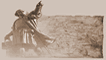
Knight.
Miniature of the
‘Customs and Privileges of
Barcelona’ (XIV century)
|
|
| |
| 
|
| |
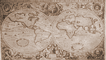
Medieval
Kingdom of Catalonia - Arago
In
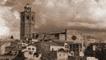
order to understand the origins of the Orobitg family from Cervera,
we have to get back to the Middle Ages, particularly in 1249 in
Cervera, where Mr Arnaldi Orvig (the first documented Orobitg until
today) lived. The village of Cervera was set up in early 1000 by
rebuilding a former fortification, which had been probably Muslim.
Following the escape of the Muslims from Cervera (and the western
part of Catalonia) in 1100, those people willing to find places
to settle together with fruitful land were attracted by the possibility
to establish themselves and their families on those lands, now far
from the Muslim threatens. In return, they lived under the protection
of the castles. |
|

|
Controlling
tower in Escaló
(Pallars Sobirà – Pyrenees, north - western side of
Catalonia) |
|
|
 |
Vassalage
The
newcomers in Cervera were allowed to be direct owners of land, thus
not being linked to any kind of vassalage relationship, whereas
in nearby villages such as Granyenella and Verdú their inhabitants
were subject to a feudal system directly linked to the Monastery
of the Virgin Mary of Poblet. The feudal regimes were quite strict
in the Kingdom of Catalonia - Arago until 1486, when as a result
of numerous fights lead by farmers the feudal servitude system was
finally abolished.
|
Monastery
of the Virgin Mary of Poblet (Tarragona, Catalonia) |
|
Religion
At that time existed multiple religious orders that were
considerably influential at all levels, from subjects to the king
itself. Moreover, in some cases, such as the ‘templers’,
priests were victims of other religious orders’ anxieties
to get further power.
Different religions coexisted at the same time, particularly Christians,
Jewish and former Muslims. The latters were working – hard
humble people that usually lived submitted to feudal conditions.
As per the Jewish, they lived in community so that they maintained
their traditions together with a high cultural level and important
financing capacities. Moreover, the Jewish were so influent that
they counted on the protection of the king. However, continuous
droughts, plagues and diseases resulted in the despair of the population
that blamed the Jewish for such sufferings. As a result, assaults
to the Jewish community were often made, whereas at the same time
they received a discriminative treatment. In the end, the Catholic
Kings signed in 1492 a decree according to which the Jewish were
to be expelled out of the country. Years later, in 1609, the former
Muslims were obliged to follow the same fate. |
|
|
 Droughts,
plagues and diseases
Droughts,
plagues and diseases |
|
The
Catalan expansion
The Kingdom of Catalonia – Arago (‘Corona Catalano –
Aragonesa’) expanded all over the Mediterranean between the
XIII and XV centuries. Trade relationships and Christian process
in Middle Eastern and North African countries were the key elements
to promote such growth, which guaranteed the Catalan presence in
Sicily, Naples, Greece, the coast of the former Yugoslavia, Turkey,
Albania, Palestine, north of Egypt, north of Africa, Cyprus, ...
|
 Catalan boat
|
|
| |
The
Catalan institutions
In the XII century, the village of Cervera was granted by the king
the privilege of having a local government. In contrast, in other
villages a ‘veguer’ (local representative of a count)
was in charge of carrying out the main public responsibilities,
such as tax collection, territorial defence, implementation of laws
and regulations related to public organisation.
When it was necessary to take decisions, the King gathered all the
counts. In a meeting the King celebrated in Cervera in 1359, it
was formally set up the Generalitat (Government of Catalonia). Later
on (late XV century), having been the Kingdoms of Catalonia –
Arago and Castilla unified, it was necessary to get the approval
by the Generalitat of any initiative from Castilla (Madrid) to implement
it.
|
|
 |
| Poster
of an exhibition related to the creation in 1359 of the Government
of Catalonia |
|
| |
|
|
|
|
|
|
|
|
|