 |
|
 |
|






|
||||||||||||||||||||
|
|
|
|
|
|
|
|
|
|
|
|
|
|
|||||||
|
|
|
|
|
|
|||||||||||||||
|
|
|
|
|
|
|||||||||||||||
|
|
|
|
|
|
|||||||||||||||
| RUSSIAN
ORIGIN |
||||||
|
Though
until now we have not been able to find evidences confirming that Orobitg
has a foreign origin, the family legend has make us being interested in
the Russian and Tartar surnames. Please note that Catalan people from
the Middle Ages said ‘Tartar’ to mean those people coming
from Oriental Europe and Russia. |
||||||
The
Horowitz family
Some
years ago, we paid attention to the surname of a famous pianist of Russian
origin, Mr Vladimir Horowitz. With a lot of imagination but no scientific
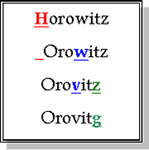
reasoning, we tried to find links between the ‘Horowitz’ and
the ‘Orobitg’ families as follows: |
 |
|||||
|
||||||
Horowitz
– Orobitg, non – verified development of the surname |
||||||
Internet
allowed us to find a wide developed web – site (www.geocities.com/horowitzassociation/)
that has confirmed that there are no origin links between the Horowitz
and the Orobitg families. Nowadays, ‘Horowitz’ is a common surname in Russia, the Czech Republic, Slovakia, Poland, Germany, Israel and the USA. This fact is quite understandable considering that Jewish people are characterised by their high mobility. |
 |
|||||
Logo
of the Horowitz Association |
||||||
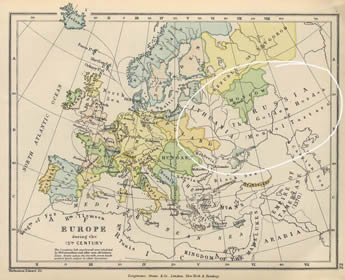
The Tartar people People coming from a wide range of destinations arrived in Catalonia from the XIII century onwards. Some came as slaves, whereas others due to trade relationships or other reasons. Some slaves of wealthy families were known as Tartar. Please note that at that time in Catalonia any person known as Tartar meant that he – she came from any country of a wide Asian area (from the Black Sea to the Pacific Ocean) that was either governed by Tartarian people or whose inhabitants came from Tartaria. |
||||||
 |
 |
|||||
Map
of Europe in the XV century. Published in 1905. It specifies the 'Tartar'
denomination under 'Russia'. The area located on the East side of the
Black Sea (marked within a cycle) was considered Tartar. |
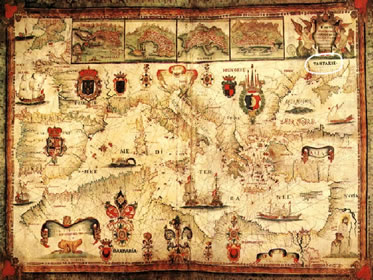
Ancient
map of Europe indicating Tartaria |
|||||
Strange though it may seem, during the Middle Ages some people travelled to distant countries. They had different reasons to do so: Christian process in the Middle East and North African countries, trade of exotic products (saffron, species, silk, tints, gold, …), immigration in order to search a new country to settle in or to escape from wars or fighting conflicts, ... |
||||||
|
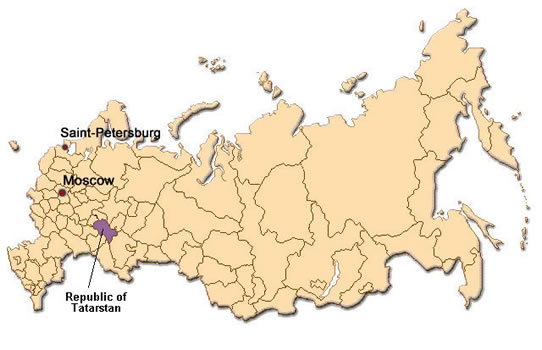
Though until now we have not been able to find any document certifying the existence of some Orobitg of foreign origin, the fact of the migratory movements of Tartarian people towards the Western European countries provide the legend of our family with a certain degree of credibility. In any case, we should not forget that the most ancient Orobitg found until now (Mr Arnaldi Orvig, Cervera, 1249) belongs to a period when the migratory movements and the expansion over the Mediterranean had just started. Mr Arnaldi Orvig (1249) was the owner of a piece of land, therefore he was not a slave. However, we should bear in mind as well that in some cases slaves were allowed to get their freedom and be owners of land properties. Nowadays, there is a Russian Republic called Tartarstan, which is located in the central area of this country. It has 3,873,600 inhabitants, 44% Russian and 48% Tartarian. |
||||||
|
|
||||||
Map
detailing the localisation of Tatarstan (2003) |
||||||

|
 |
 |
 |
 |
 |
 |
|||||
 |
 |
 |
 |
 |
 |
||||||